If you run a marble, granite, or engineered-stone workshop, you already know that a CNC stone router lives and dies by its water system. Stone cutting and engraving generate an enormous amount of fine mineral slurry, and unlike wood or acrylic routing, you cannot simply run this process dry. Water is not optional on a stone router — it is the single most important consumable system on the machine, right after the spindle itself.
Yet most first-time stone router buyers focus entirely on spindle power, gantry rigidity, and axis speed, and treat the water recirculation and filtration system as an afterthought. That’s a costly mistake. A poorly designed or poorly maintained water system leads to clogged pumps, damaged spindle bearings, inconsistent cut quality, higher water bills, and unnecessary downtime. A properly set up system, on the other hand, can run for years with minimal intervention while keeping your slurry disposal costs near zero.
In this guide, we’ll break down exactly how water recirculation and filtration systems work on CNC stone routers, why they matter so much, how to set one up correctly, and how to avoid the mistakes that cause most workshop breakdowns.
Why Water Matters So Much in CNC Stone Routing
Stone — whether it’s marble, granite, quartz, or engineered composite — is abrasive and produces a fine mineral dust the moment a router bit touches it. Unlike wood dust, stone dust is heavier, sharper, and far more damaging if it becomes airborne or gets into moving machine parts.
Water is introduced at the cutting point for three critical reasons:
- Cooling the tool and the stone. Diamond and carbide router bits generate intense friction heat when cutting dense stone. Without continuous water cooling, bits overheat, lose their edge rapidly, and can even crack the stone from thermal stress.
- Suppressing dust. Dry stone cutting throws respirable silica dust into the air — a serious health hazard for operators and a housekeeping nightmare for the workshop. Water instantly binds this dust into slurry, keeping it out of the air and out of your machine’s electronics.
- Lubricating the cut. A steady water film reduces friction between the bit and the material, resulting in cleaner edges, better polish-readiness, and longer tool life.
Without water, none of this happens — which is exactly why every serious CNC stone router machine is built around an integrated water delivery system.
What “Recirculation and Filtration” Actually Means
A basic water-fed CNC stone router simply sprays fresh water onto the cutting zone and lets it drain away with the slurry — a huge waste of water, and a plumbing and disposal headache in any workshop that runs more than a few hours a day.
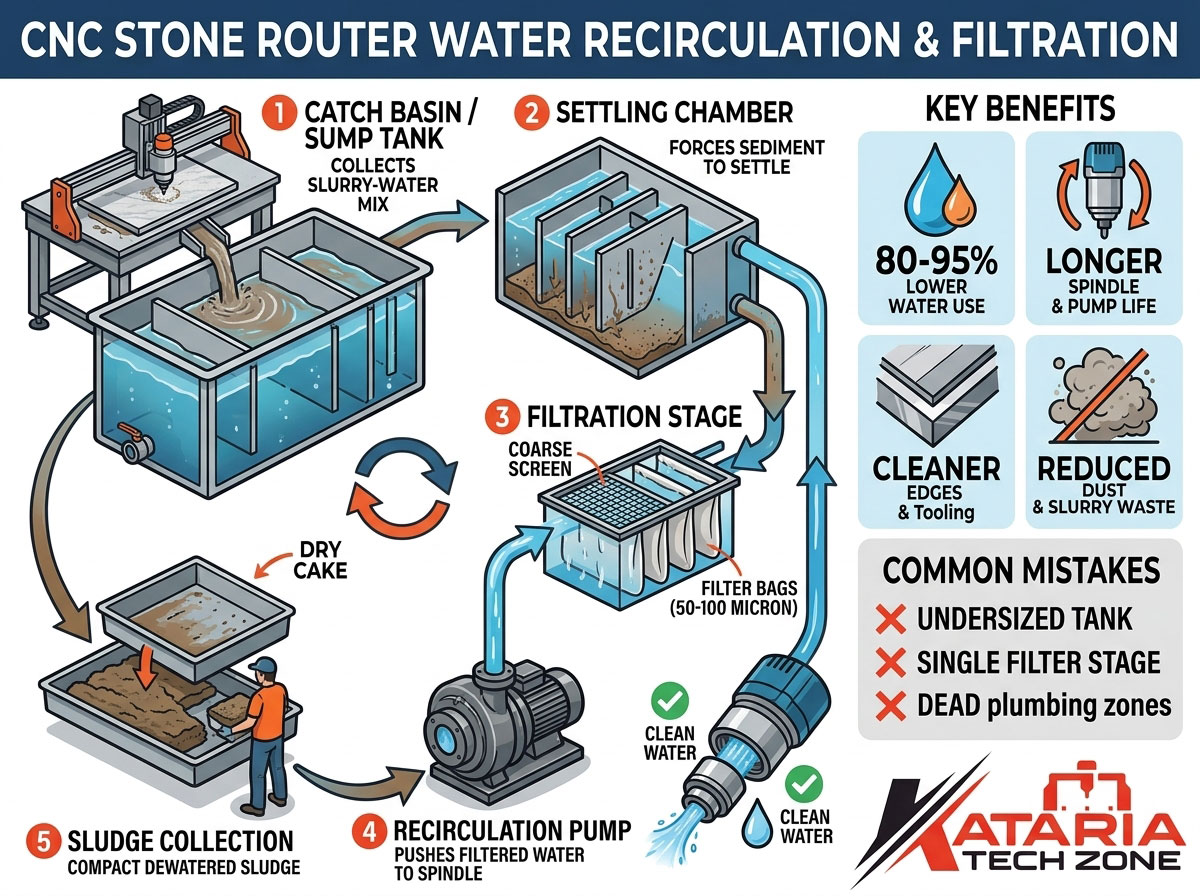
A recirculation and filtration system solves this by capturing that used water, cleaning it, and sending it back to the spindle nozzle in a continuous loop. In practice, the system consists of five core components working together:
- Catch basin / sump tank — collects the water-slurry mixture that drains off the worktable.
- Settling or sedimentation chamber — allows heavier stone particles to sink to the bottom before the water moves further into the system.
- Filtration stage — mesh screens, filter bags, or multi-stage filter cartridges that trap the remaining fine particulate before the water is considered “clean.”
- Recirculation pump — pushes filtered water back up to the spindle-mounted nozzle or water ring at controlled pressure.
- Sludge collection point — a removable tray, bag, or press where the trapped stone sediment accumulates for easy disposal.
Done correctly, this loop can reuse the same water for weeks, topping up only for evaporation and the small amount that leaves the system as damp sludge.
Setting Up a Water Recirculation and Filtration System: Step by Step
1. Size the Sump Tank to Your Machine and Workload
The sump tank is the heart of the system. It needs enough volume to let particles settle before water reaches the pump intake — a tank that’s too small recirculates dirty water almost immediately, which shortens pump life and clouds your cuts. As a rule of thumb, workshops running a mid-size CNC stone router for multi-shift production should budget for a tank at least large enough to hold 15–20 minutes of continuous water flow at full pump output, with a minimum of two internal baffles to slow the water and force settling.
2. Install a Multi-Stage Filtration Path
Never rely on a single filter stage. The best-performing setups use:
- A coarse mesh screen at the tank inlet to catch large chips and debris immediately.
- A sedimentation zone with baffle walls, where slower-moving water drops most of its suspended fines by gravity.
- A fine filter bag or cartridge (commonly 50–100 micron) as the final polishing stage before water reaches the pump.
This staged approach means each filter component only has to handle what the previous stage missed, dramatically extending filter life and reducing how often you need to intervene.
3. Choose the Right Pump
The recirculation pump needs to match your spindle’s water requirement in both flow rate (litres per minute) and pressure — undersized pumps starve the cutting zone of coolant, while oversized pumps waste energy and can cause splash-back. Submersible sump pumps are common for smaller setups; larger production floors often use an external centrifugal pump feeding a pressurized manifold to multiple machines.
4. Route Plumbing to Avoid Dead Zones
Poor pipe routing is one of the most common (and most avoidable) setup mistakes. Dead zones in the plumbing — low points with no flow — become sediment traps that clog lines over time. Keep return lines sloped toward the sump, avoid unnecessary elbows, and use clear or semi-clear sections at key inspection points so you can visually check flow and catch early signs of a building clog.
5. Add a Sludge Management Step
Even with excellent filtration, sediment has to go somewhere. The most efficient shops route trapped sludge into a removable bag, cassette, or basic filter press that dewaters the slurry into a compact solid cake. This turns a liquid-waste disposal problem into a simple dry-waste one, which is both cheaper and far friendlier to local drainage regulations.
6. Set a Maintenance Schedule
A recirculation system is only as good as its upkeep. At minimum, plan for:
- Daily: Quick visual check of nozzle flow and water clarity.
- Weekly: Empty or replace coarse filter screens; check pump inlet for blockage.
- Monthly: Drain and clean the sump tank fully, inspect baffles for sediment buildup, and check pump seals.
- Quarterly: Replace fine filter cartridges/bags and inspect all plumbing joints for scale or corrosion.
Skipping this schedule is the #1 reason workshops end up with premature pump failures and spindle bearing damage — problems that a $20 filter bag change could have prevented.
Key Benefits of a Proper Water Recirculation and Filtration System
1. Dramatically Lower Water Consumption
Recirculation can cut fresh-water usage by 80–95% compared to a straight drain-to-waste setup, since the same water is filtered and reused continuously instead of being discharged after a single pass.
2. Longer Spindle and Pump Life
Clean, well-filtered water means no abrasive grit reaching seals, bearings, or pump impellers. This alone can add years to the service life of your spindle and pump — two of the most expensive components to replace on any CNC stone router machine.
3. Consistent, High-Quality Cuts
Stable water pressure and clean coolant flow mean stable cutting temperatures, which translates directly into cleaner edges, fewer micro-cracks, and more predictable tool wear — critical when you’re engraving fine detail work or cutting tight-tolerance inlays.
4. Reduced Airborne Silica Dust
A well-maintained water system keeps dust suppression consistent throughout the shift, protecting operator health and keeping the workshop compliant with dust-exposure safety norms.
5. Lower Operating Costs Over Time
Between water savings, extended component life, and reduced downtime, most workshops recover the cost of a proper filtration setup within the first year of heavy production use.
6. Cleaner Workshop Floor and Drainage
Instead of slurry running across the shop floor or straight into municipal drains, a closed-loop system keeps waste contained, easier to manage, and far less likely to attract regulatory attention.
Common Mistakes to Avoid
- Undersizing the sump tank to save floor space — this is the single biggest cause of premature pump and nozzle failure.
- Using only one filtration stage, which clogs fast and forces daily cleaning instead of a manageable weekly/monthly cycle.
- Ignoring pipe slope, creating sediment traps that silently choke flow over weeks until the pump runs dry.
- Skipping scheduled maintenance because the system “seems to be working fine” — by the time a problem is visible, it has usually already damaged a pump or bearing.
- Mixing incompatible pump materials with abrasive stone slurry — always confirm your pump housing and impeller are rated for abrasive-particle service, not just general water transfer.
Choosing the Right CNC Stone Router With Water System in Mind
When evaluating a CNC stone router machine, don’t just ask about spindle power and axis travel — ask the manufacturer specifically about the water recirculation design: tank capacity, filtration stages, pump specification, and how accessible the sludge tray is for daily cleaning. A machine with a thoughtfully engineered water system will cost you far less in consumables and downtime over its working life than one where filtration was clearly an afterthought.
At Kataria Tech Zone, our stone routers are engineered with production-grade water recirculation and multi-stage filtration built in from the ground up — not bolted on later. If you’re setting up a new stone engraving or cutting line, or upgrading an existing one, our team can help you size the right water system for your workload, material mix, and shift pattern.
Related Reading
- The Ultimate Guide to CNC Stone Routing: Expanding Your Workshop into Marble and Granite Engraving
- How to Prevent Tool Breakage on CNC Routers: Bit Selection & Speed Optimization
- Mastering CNC Routing on Solid Wood vs. Engineered Wood: Tooling, Feeds, and Speeds
Explore Our Machines
Frequently Asked Questions
How often should I change the water in a CNC stone router’s recirculation tank? With proper multi-stage filtration, a full tank drain and clean is typically needed monthly for moderate use, though heavy multi-shift production may require it every two to three weeks.
Can I retrofit a filtration system onto an older stone router that only drains to waste? Yes. Most workshops can add an external sump tank, filter stage, and recirculation pump alongside an existing machine’s drain outlet without modifying the router itself.
What micron rating should the final filter stage use? A 50–100 micron final filter bag or cartridge is standard for most stone routing applications, balancing fine particle capture against flow rate and filter life.
Does hard or mineral-heavy water affect the system? Yes — hard water accelerates scale buildup in pumps and nozzles. Where local water is hard, a simple inline scale-reducing filter on the fresh-water top-up line extends component life significantly.
Need help designing the right water recirculation and filtration setup for your workshop? Contact Kataria Tech Zone — India’s trusted manufacturer of CNC stone routers, CNC wood routers, and laser cutting machines — for expert guidance tailored to your production line.